École des Beaux-Arts
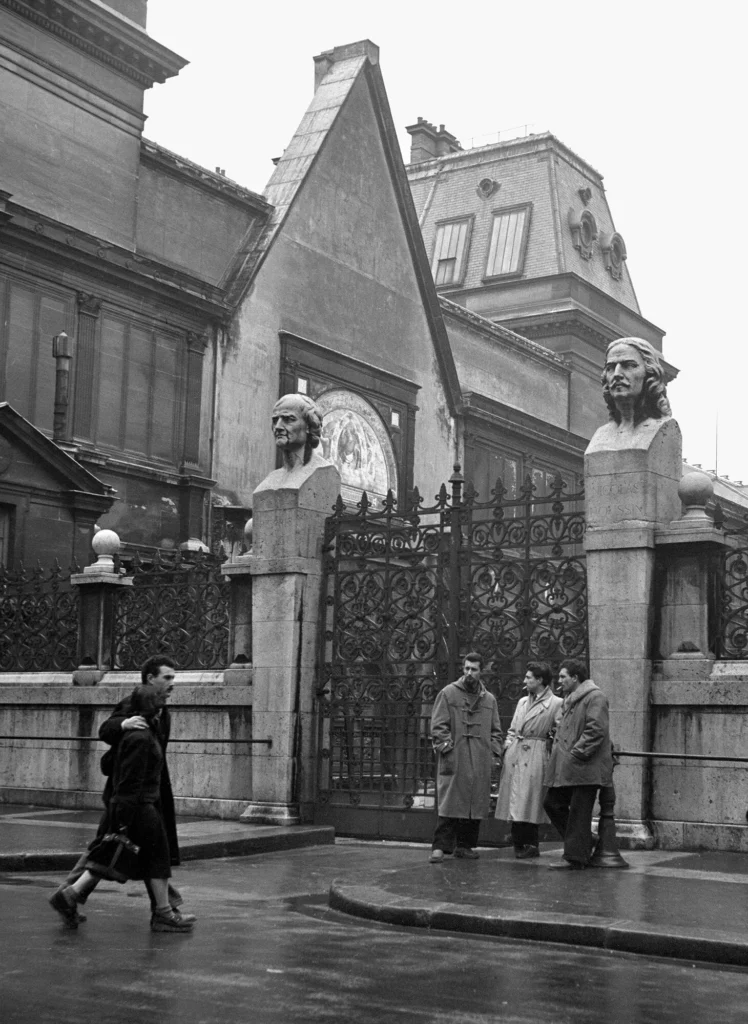
The École des Beaux-Arts, founded in 1671, was one of the principal institutions of academic art training in France. In 1793, it was reorganized through the merger with the Académie Royale de Peinture et de Sculpture. The school offered instruction in drawing, painting, sculpture, architecture, and engraving to students admitted through a competitive examination system, establishing a rigorous academic framework that shaped generations of artists.
The institution is housed within a historic complex on Rue Bonaparte on the Left Bank, comprising interconnected buildings including the Palais des Études (often referred to as the Palais des Beaux-Arts), studios, courtyards, and exhibition spaces., such as the Galerie des Beaux-Arts, where the first Salon des Jeunes Peintres was held.
Among its many notable students were Jean-Auguste-Dominique Ingres, Eugène Delacroix, and later Edgar Degas, reflecting its foundational role in academic and early modern art.
In 1948, Ellsworth Kelly enrolled as a full-time student under the provisions of the G.I. Bill. He studied under Jean Souverbie and met fellow student Jack Youngerman, situating his early development within this academic environment.
In 1949, Kelly exhibited at the Salon des Jeunes Peintres for the first time in Europe, presenting works such as Wood Cutout with String III (1949).
The École des Beaux-Arts thus functioned not only as a site of formal instruction but also as an institutional framework through which artists entered the Parisian art world.