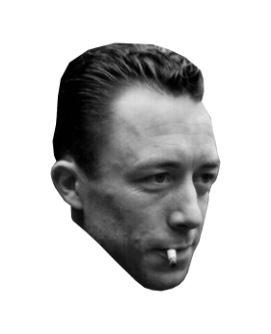
Albert Camus
Albert Camus (1913–1960) was a French-Algerian writer, philosopher, and journalist, associated with existentialism and the philosophy of the absurd. He lived and worked in Paris, where he became a central figure of the postwar intellectual milieu and was awarded the Nobel Prize in Literature in 1957.
Albert Camus and Jean-Paul Sartre were initially close friends and intellectual allies before becoming one of the most famous rivalries in postwar French intellectual life.
In the 1940s, both figures were associated with the Parisian existentialist milieu surrounding Saint Germain des Prés, left wing politics, and journals such as Combat and Les Temps modernes. Sartre admired Camus’s early works, especially The Stranger and The Myth of Sisyphus, while Camus respected Sartre’s philosophical influence. During and immediately after the Second World War they moved within overlapping literary, theatrical, and political circles.
Their relationship deteriorated sharply in the early 1950s, particularly after the publication of Camus’s The Rebel (1951), in which he criticised revolutionary violence and totalitarian tendencies within Marxism. Sartre and his circle, especially Francis Jeanson in Les Temps modernes, attacked the book publicly, accusing Camus of political naïveté and insufficient engagement with history and class struggle. Camus responded in an open letter, and Sartre replied with a harsh rebuttal, effectively ending their friendship.
At the core of their conflict were different ethical and political positions. Sartre increasingly defended revolutionary commitment and Marxist engagement, while Camus insisted on moral limits, individual conscience, and opposition to ideological violence from both the right and the left. Their rupture came to symbolise a broader division within postwar French intellectual culture between revolutionary politics and ethical humanism.
Artists