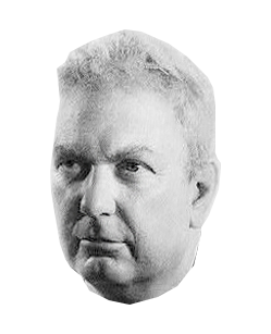
Alexander Calder
Alexander Calder (1898–1976) was an American sculptor best known for his invention of the mobile, a form of kinetic sculpture activated by air currents, as well as for his large-scale stabiles. After settling in France in the late 1920s, Calder became one of the most prominent American artists working in Paris. He was also closely connected to Aimé Maeght’s circle of artists, and his first exhibition at Galerie Maeght, featuring fifty-two sculptures, opened in July 1950.
Ellsworth Kelly met Alexander Calder in May 1950, having been introduced to Alexander and Louisa Calder in Paris through the archaeologist and collector Henri Seyrig, Jack Youngerman’s father-in-law, who had previously met the couple in the United States. The support and encouragement Calder extended played a significant role in Kelly’s development as an artist. As Kelly later recalled, “I loved him and thought of him as a father figure.”
The supportive nature of this relationship manifested primarily in practical terms and through networking. Their relationship remained largely meritocratic, with neither artist seeking a traditional mentor–disciple dynamic, despite the significant difference in their age and professional standing: Kelly was a twenty-seven-year-old who had not yet been granted a solo exhibition, while Calder, at fifty-two, had already achieved the status of a maître.
Barbara Chase-Riboud met Calder in 1964, when she became his neighbor in the Loire Valley. At that time, she had established her country studio La Chenillière.
Artists
Dealers
Institutional Figures
Publishers and master printers
Exhibitions & Events
Galerie Maeght
-
'Calder: Mobiles & Stabiles'
-
Calder
DLM No. 69–70. Calder. Texts by Frank Elgar and Henri Pichette. October–November 1954.
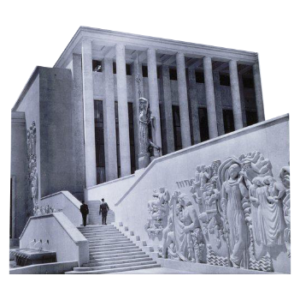
Musée National d’Art Moderne
-
12 Peintres et Sculpteurs Américains Contemporains, 1953
The exhibition was one of the earliest institutional presentations of American modern and contemporary art in postwar France. The exhibition signaled a shift in curatorial emphasis by introducing French audiences to artists whose work challenged the aesthetic dominance long associated with the School of Paris.
Exhibited artist: Jackson Pollock, Ivan Le Lorraine Albright, Arshile Gorky, Stuart Davis, Morris Graves, Edward Hopper, John Kane, John Marin, Ben Shahn, Alexander Calder , Theodore Roszak, David Smith -